
ESRS 2 Strategy
SBM-1 Strategy, business model and value chain
Sandvik is a global, industrial technology group providing solutions that enhance productivity, profitability and sustainability for the mining, manufacturing, and infrastructure industries. We have approximately 43,000 employees and sales in more than 150 countries. Further details about our employees are found under S1-6. Our purpose “Advancing the world through engineering” has been adopted by the Group Executive Management and approved by the Board, and forms the basis for who we are. The purpose is supported by our core values, which together with the Code of Conduct, guides us in our daily business decisions and forms the basis of our strategy.
Our strategy aims to create benefits for all our stakeholders – customers, employees and communities, ultimately leading to shareholder value. It rests on our core values, explicit target setting, and a decentralized way of working. Business area, divisional, and function strategies are all guided by the Sandvik Group strategy, but adapted to fit the specific characteristics, opportunities and challenges for each individual part of the business. The strategy includes six strategic objectives for which Sandvik has defined 2025 targets and key results.
The strategic objectives includes Digital shift, Shift to growth, Sustainability shift, Employer of choice, Agile through cycle, and Customers 1st choice. Elements of sustainability are integrated in all of these areas. Sustainability is a major business opportunity for Sandvik, and our solutions help our customers improve productivity, safety, and resource efficiency in their operations. Sandvik aims to be the employer of choice within our industries and attract, retain, and develop diverse talents to drive our strategy.
The ambition with the Sustainability shift is to fully integrate sustainability into business. We have five focus areas within sustainability that support our strategy and long-term sustainability ambitions. Our focus areas include Sustainable solutions, Net Zero, Circularity, People and communities, and Responsible business. Sustainable solutions aims to lead industry innovation through solutions that are clearly differentiated on sustainability, driving value, and creating substantial sustainability gains for our customers and society. About 65 percent of the emissions in our value chain derive from the use of our products. The largest contribution we can make is to help our customers undergo a sustainable transition in mining, manufacturing, and infrastructure through the solutions we provide. Our focus on net zero includes our validated SBTi net zero targets to 2050. We develop products and solutions that strengthen customer efficiency and improve environmental impact related to water, pollution, and greenhouse gas emissions. In our operations we drive efficiency improvements, and we engage our key suppliers in their transition. For people and communities we focus on our safety-first culture working to protect and advance people in our business. We work to respect human rights in our value chain and support resilient communities around us. Responsible business highlights Sandvik commitment to maintaining high standards of business conduct and responsibility built into our operations and throughout our value chain, enabled by transparency and due diligence.
An overview of our value chain and material impacts, risks, and opportunities is found under SBM-3. 2025 is the final year for the current strategy period. As of 2026, the updated five-year strategy, Advancing to 2030, will be implemented.
Business model
Inputs – what we use to create value
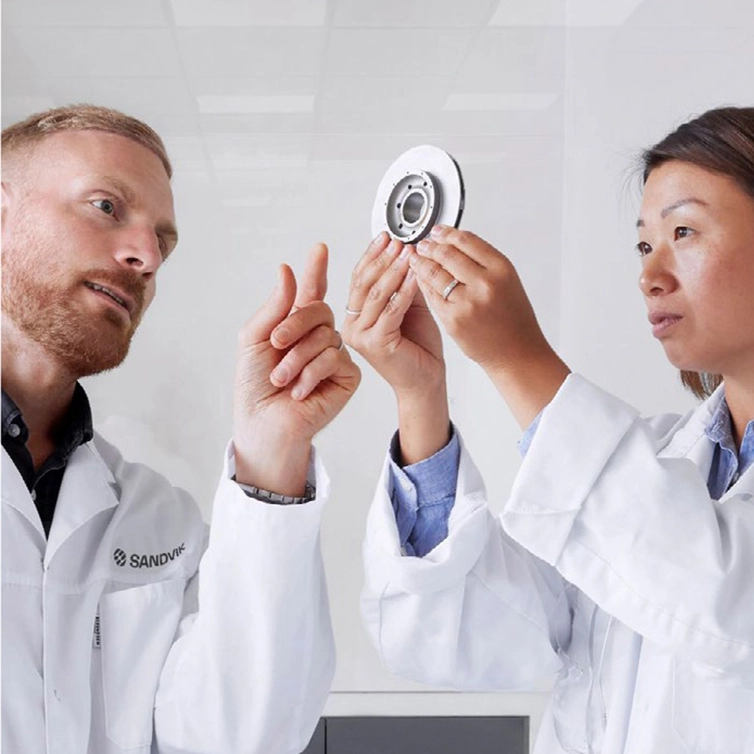
Employees
Sandvik utilizes the expertise and experience from our employees, together with insights from close collaboration with customers and suppliers, to develop innovative products and solutions.
Innovation
Sandvik has research and development, and product development at its core, which we use to drive sustainable innovations. We always strive for technology leadership and successful partnerships.
Resources
Energy, raw materials, and components are essential for Sandvik production, and we continuously focus on resource efficiency to minimize the environmental footprint and drive productivity.
Social
We actively engage in the communities where we operate, benefiting our employees and society.
Business activities – how we operate
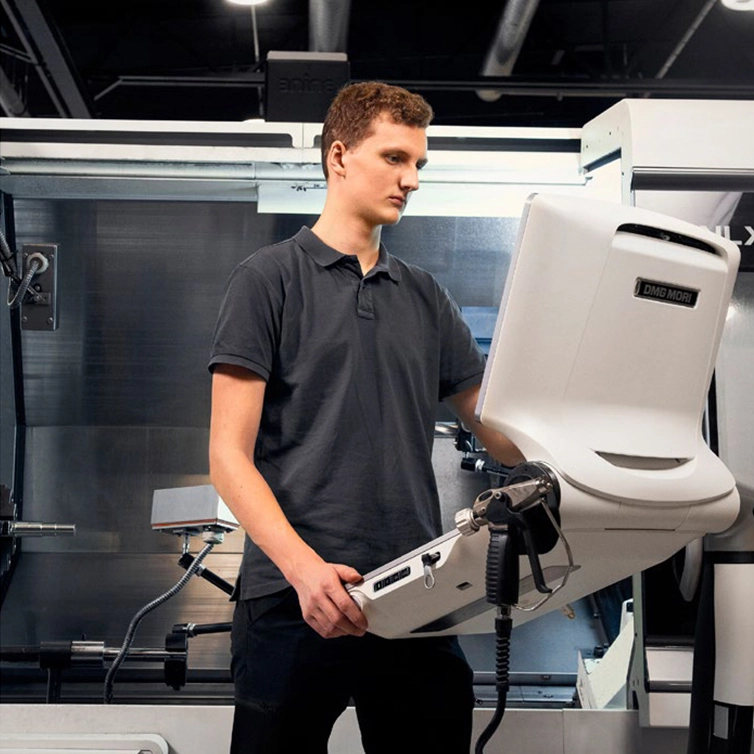
Operations
Sustainability integrated into operations lead to resource efficiency, cost saving, and improved risk management.
Lean manufacturing, waste minimization, and energy efficiency improve operational performance and reduce environmental impact, while supporting a circular economy.
Leveraging technology and digitalization for improved transparency and data driven decision making.
Our governance framework, The Sandvik Way, and our Code of Conduct enables responsible business of sustainability topics in the value chain.
Outputs – what we deliver and how we create value
Sandvik develops world-leading products and solutions designed for improved productivity, efficiency, and sustainability.
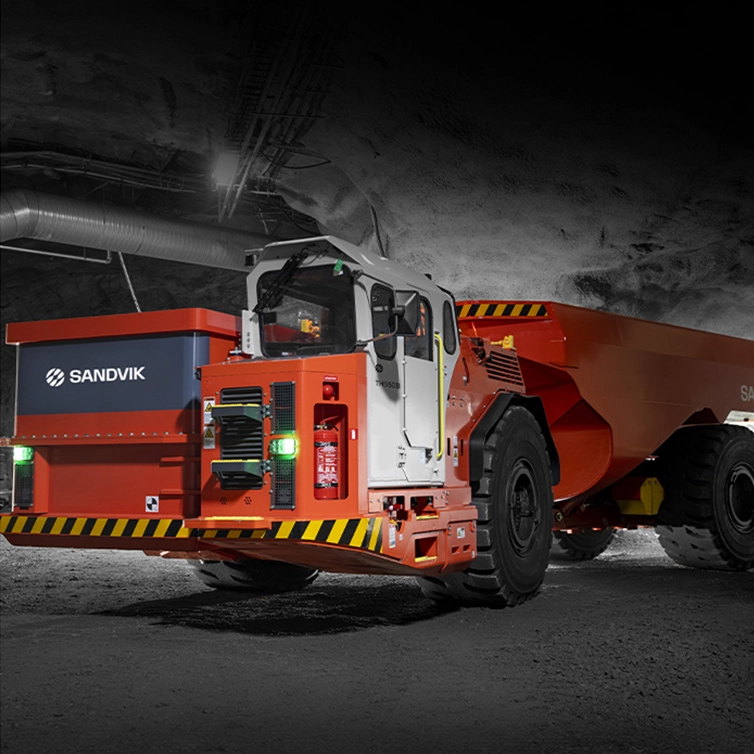
We deliver equipment, such as drill rigs, rock drilling tools and systems, load and haul machines, tunneling equipment, continuous mining and mechanical cutting equipment, crushing and screening equipment, parts and services, mine planning software, and ground support for the mining and infrastructure industries.
Sandvik is a leader in electric and autonomous mining equipment. Electric mining equipment reduces CO2 emissions, heat and noise. Autonomous mining equipment enables remote fleet control which removes operators from hazardous areas and increases their safety.
Eco-efficient rock processing equipment reduces the energy used per ton of material crushed at the customer site and extends service intervals. The grinding phase is very energy consuming. By working close to customers to optimize comminution circuits, Sandvik can reduce the material size from the crushing plant. Replacing grinding by fine crushing is up to ten times more energy efficient compared to conventional grinding.
Sandvik offers leading solutions for the component manufacturing industry, with engineering, automotive and aerospace as its major customer segments. Our tools and tooling systems for metal cutting and our manufacturing software make component manufacturing more productive, energy efficient and less resource intensive. We aim to optimize, automate and connect the component manufacturing value chain, from design and planning to preparation, production and verification. Circularity includes all parts of the product lifecycle, from design and sourcing to use, and resource recovery.
We create economic value for society through revenues, taxes and wages. Community engagement projects contribute to local economies and communities.
SBM-2 Interests and views of stakeholders
Sandvik has identified a range of stakeholders who are likely to be impacted by the company or have the potential to influence Sandvik. Stakeholder interests are taken into consideration in the strategic planning. We engage with stakeholders to gain insights into their relationships with Sandvik and also to support in identifying potential impacts, risks, and opportunities as part of our materiality assessment. Where dialogues have had an impact on strategy and business model, this is further described in the stakeholder table. Stakeholder engagement is managed through the operational structure.
Sustainability is an integrated part of the reports submitted to the Audit Committee on a regular basis.
Stakeholder group |
Type of engagement |
Connection to strategy and business model |
|---|---|---|
Customers |
Dialogues with customers focused on key areas such as product development for enhanced safety, increased energy efficiency, and electrification. |
Customers inform our product development and offering. Customer feedback is directly linked to sustainable solutions in our strategy. |
Employees and employee representatives |
Continuous communication with employees is ensured through regular meetings, employee surveys and performance dialogues. Sustainability-related perspectives are integrated into Sandvik employee surveys. Sandvik maintains regular interactions and discussions with unions regarding the sustainability agenda. In the Double Materiality Assessment (DMA) Sandvik included diverse perspectives and experience on social topics from internal experts, and outcomes from employee surveys, Speak Up, and other relevant internal processes. |
Employees and employee representatives provide valuable input to ESG programs and shape actions and improvement plans to address any issues. Learnings from engagement activities are analyzed and integrated where appropriate into our people strategy. |
Shareholders |
Sandvik actively engages with shareholders to discuss the implementation of strategic initiatives, the impact of sustainability goals on Sandvik business, specific targets and outcomes, and our contributions to the UN Sustainable Development Goals (UNSDG). |
The Board of Directors and Group Executive Management uses this information in the strategic planning for the Group and updated the guidance to management as appropriate, considering the overall balance of different interests. |
Suppliers and workers in the value chain |
Sandvik actively participates in industry forums to advocate for responsible sourcing of minerals and has collaborated in the development of common industry tools and standards to amplify impact. This engagement includes conflict-affected and high-risk areas, either directly or through subsidiaries. Our involvement includes memberships in the Responsible Minerals Initiative, Cobalt Institute, and the Tungsten Conflict Minerals council. Within the DMA we included different internal perspectives and experiences, and considered external reports, legislation, and frameworks. External sources included reports on working conditions and impacts in relevant industries, supplier risk screenings, and supplier audits. |
Supports the understanding and effectiveness of our supplier practices and commitment. Engagement provides learnings of market-specific conditions and challenges and possible improvements to our supply chain programs. |
Policymakers, regulators and authorities |
We engage with governments indirectly on ESG issues through industry associations. Relevant legislations and frameworks that had the potential to influence the assessment were reflected in the DMA. |
Ensure we adhere to regulations. Through continual engagement and dialogue with key policymakers and regulators, we increase our alignment with their objectives, refining our internal policies and business strategies. |
NGOs and sustainability experts |
Sandvik is a signatory of the UN Global Compact (UNGC) and is active in various industry associations such as Jernkontoret, Svemin, the International Council of Swedish industry (NIR), the Cobalt Institute, the International Tungsten Industry Association, the Responsible minerals initiative, and the Tungsten industry conflict minerals council. In the DMA we have considered reports and views from these organizations. |
Access to valuable insights, expertise and best practices which help us identify potential Impacts, Risks, and Opportunities (IROs). Supports in developing relevant ambitions and actions. This may then be integrated into our ESG policies, targets and actions. |
Affected communities and nature |
We strive to be an engaged partner in the communities in which we operate. Affected communities and nature as a silent stakeholder are taken into consideration in the DMA assessment through reports on environmental and social impact, and engagement with community representatives and employees through internal experts as well as scientific studies. |
Informs decisions on community engagement programs and actions on environmental issues. |
SBM-3 Material impacts, risks, and opportunities and their interaction with strategy and business model
Sustainability is integrated in our strategy and represents a major business opportunity for Sandvik. Our solutions help our customers improve productivity, safety, and resource efficiency in their operations. Through our technology leadership and innovation capabilities in areas such as automation, digitalization, and electrification, we have a unique opportunity to drive sustainability in our customers’ industries.
We have a clear strategy for driving long-term growth and resilience. Sandvik has a strong platform to leverage on, with global market leading positions, a decentralized operating model, a strong corporate culture, and financial strength. We continuously look at means of improving ways of working, optimizing organizational structure, and strengthen our operational efficiency. Strengthening and reviewing the resilience of our strategy and business model is integrated in our strategy development. To effectively identify and manage risk is an important element of business success for all parts of Sandvik. Sandvik has an Enterprise Risk Management (ERM) program to support the day-to-day risk management within operations. It covers all business areas, divisions, and functions within the Group. Impacts are managed throughout the business with activities to mitigate negative impacts and strengthen positive ones.
Sandvik aims to be a positive force in shaping the industries of the future, using our expertise and skills to support a sustainable future. In each of our businesses and value chains, we have the opportunity to enable the transformation through innovative sustainable solutions, collaboration with our customers and suppliers, and incorporating responsibility and transparency at every level.
Sandvik has set a clear goal to reduce its greenhouse gas impact across the entire value chain. Our largest impact is through the use of our products and solutions, and we continuously strive to increase productivity and minimize the environmental impact. We aim to increase circularity by using more secondary material in our production and circular business models.
Sandvik has performed a double materiality assessment (DMA) to identify material topics. This assessment was supported by topics included in the Corporate Sustainability Reporting Directive (CSRD) and considered dependencies on natural, social, and human resources. The assessment resulted in material impacts, risks, and opportunities, and forms the basis of this year’s CSRD reporting.
Our DMA identified material Impacts, Risks, and Opportunities (IRO) across nine topical standards. The illustration and table on the following pages provides a consolidated list of all our material IROs identified in the 2025 DMA throughout our value chain. A more detailed overview of material IROs specific to each topic is shown under each topical standard. Among our material topics, we have identified four financial risks and four financial opportunities, described in the relevant sections of this report. The illustration includes the value chains that have been assessed in the DMA as likely to generate material impacts, risks, and opportunities. Sandvik is connected to the impacts in our value chain through our business relationships. Our IROs have been assessed over the short, medium, and long-term time horizons.
At the end of the reporting year, we have not identified any material risks and opportunities for which there is a significant risk of material adjustment to the carrying amounts of assets and liabilities in the next annual reporting period.
Sandvik comprises 23 divisions, grouped into three business areas within mining, infrastructure, and manufacturing industries. These are world-leading businesses that share a common purpose and business models to help our customers become more efficient, productive, and sustainable. Sandvik strives to be an enabler in our customers’ shifts through a strong focus on innovation and a leading offering in new technologies, digitalization, automation, and sustainable solutions. Sustainability is integrated into our strategy, and our business areas integrate the sustainability shift into their business, through products and services, and activities in their own operations. To fulfill global climate targets, the electrification of society is required, and there is an increasing demand for minerals and fossil fuel-free energy sources. Sandvik is world-leading in electric mining equipment, and supplies tools and tooling systems for the energy industry, including renewable energy. Our largest impact is through our products, and we continuously strive to increase productivity and minimize environmental impact. We aim to increase circularity by using more secondary material in production. We repurchase customers’ used cemented carbide inserts, drill bits, and rock tools, and use them to manufacture new tools. We also provide refurbishment of equipment in mining, crushing, and screens. For sustainable solutions we have developed a framework that will serve as the basis for a common way of working and target-setting. We have introduced numerous innovations with a focus on automation, digitalization, and electrification. These improve efficiency and productivity while reducing emissions and waste.