
Corporate governance model
1. Shareholders
As of December 31, 2025, the Sandvik share capital amounted to SEK 1,505,263,107.60 represented by 1,254,385,923 shares. At year-end, Sandvik had about 136,000 shareholders and AB Industrivärden was the largest owner with about 14.95 percent of the share capital. Of the total share capital at year-end, about 45 percent was owned by investors outside Sweden.
More information about the Sandvik share and ownership structure in Our share.
2. Shareholders’ meeting
The General Meeting of Shareholders is the highest decision-making body. At the Annual General Meeting, the shareholders are given the possibility to exercise their voting rights in relation to, for example, the Annual Report, dividends, the election of the Board, the appointment of auditor and other matters stipulated in the Companies Act, the Articles of Association and, where applicable, the Code.
All shareholders who have been entered in the share register and have informed the company of their participation within the time limit stated in the notice of the General Meeting are entitled to participate at the General Meeting and exercise their voting rights in respect of the shares held. Shareholders are also entitled to be represented by a proxy at a General Meeting. According to the Articles of Association, the Board may also decide to allow shareholders to exercise their voting rights through postal voting before the General Meeting.
All Sandvik shares carry equal voting rights with one vote per share.
2025 Annual General Meeting
At the Annual General Meeting held on April 29, 2025, shareholders representing 62.4 percent of the share capital and votes participated. Resolutions included the following:
Dividend of SEK 5.75 per share
Re-election of Board members Claes Boustedt, Marika Fredriksson, Johan Molin, Andreas Nordbrandt, Susanna Schneeberger, Helena Stjernholm, Stefan Widing and Kai Wärn as well as re-election of Johan Molin as Chairman of the Board
Election of Öhrlings PricewaterhouseCoopers AB as auditor
Approval of the Board’s remuneration report
Adoption of a long-term incentive program in the form of a performance share program for about 350 senior executives and key employees in the Group
Authorization for the Board to decide on the acquisition of the company’s own shares up to a maximum of 10 percent of all the shares in the company
For additional information about the Annual General Meeting, including the minutes, visit home.sandvik.
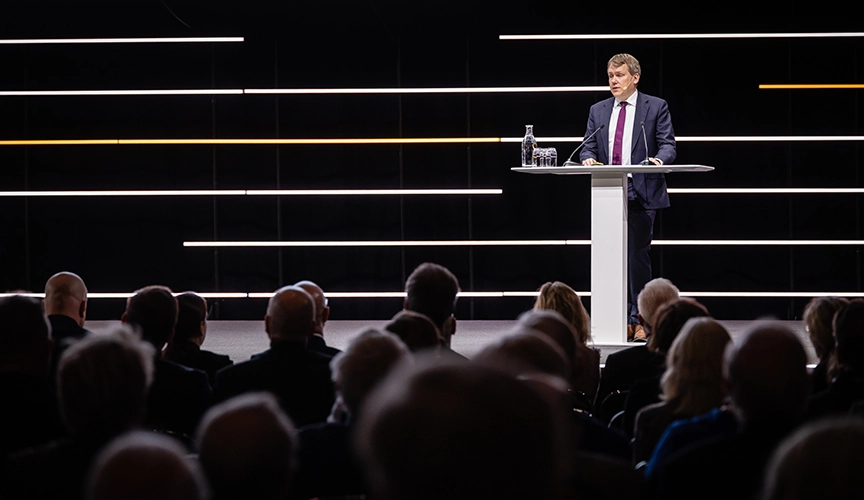
2026 Annual General Meeting
The next Annual General Meeting will be held in Sandviken, Sweden, on April 28, 2026. More information can be found in the notice convening the General Meeting and at home.sandvik.
3. Nomination Committee
The main task of the Nomination Committee is to prepare and submit proposals to the General Meeting regarding election of Chairman of the meeting, the Board members and Chairman of the Board, appointment of the auditor, and fees to Board members who are not company employees and to the auditor. The Annual General Meeting has adopted instructions for the Nomination Committee, which include procedures for appointing the Nomination Committee, valid until the General Meeting resolves on a change. In accordance with these instructions, the Nomination Committee shall consist of members appointed by each of the four largest shareholders in terms of the number of votes on the final business day in August plus the Chairman of the Board (convener).
Nomination Committee for the 2026 Annual General Meeting
For the 2026 Annual General Meeting, the Nomination Committee consists of:
Fredrik Lundberg, Chairman (Industrivärden),
Oscar Bergman (Swedbank Robur Funds),
Lars Pettersson (Lundbergs),
Daniel Kristiansson (Alecta) and
Johan Molin (the Chairman of the Sandvik Board).
Up to the date of this Annual Report, the Nomination Committee met on three occasions. The Nomination Committee was informed of the results of the Board’s own evaluation. The Committee met with the President and CEO and the CFO, who presented the company’s strategy. The Nomination Committee discussed the general criteria that Board members should fulfill, including the independence requirement, and reviewed the number of Board assignments that each Board member has in other companies. The Nomination Committee applied rule 4.1 of the Code as the diversity policy. This rule states that the Board shall have an appropriate composition in view of the company’s operations, phase of development and other relevant circumstances, display diversity and breadth in terms of qualifications, experience and background of the Board members elected by the General Meeting, and that the company shall strive for gender balance.
4. Board of Directors
The Board is responsible for the company’s organization and the management of the company’s business. The Board is required to continuously monitor the company’s and the Group’s financial position.
The Board ensures that the company’s organization is designed in a way that ensures that the financial statements, the management of assets and the company’s financial condition in general are controlled in a satisfactory manner. The Board also adopts the strategy for the Group and monitors the performance and compliance with relevant rules and strategic plans.
The President is appointed by the Board and is responsible for the daily operations pursuant to guidelines and instructions issued by the Board. The distribution of responsibilities between the Board and the President is laid down in the Board’s Procedural Guidelines which are reviewed and adopted each year. The review is based on aspects such as the Board’s evaluation of the individual and collective work that the Board performs.
In addition to financial reporting and the monitoring and follow-up of daily operations and profit trend, Board meetings address the goals and strategies for the operations, significant acquisitions and investments, as well as matters relating to the capital structure. Senior executives report business plans and strategic issues to the Board on an ongoing basis.
Composition and competence
As of December 31, 2025, the Sandvik Board consisted of eight members elected by the Annual General Meeting. The Nomination Committee communicated before the 2025 Annual General Meeting that it had applied rule 4.1 of the Code as the diversity policy. The current Board composition is the result of the work of the Nomination Committee prior to that General Meeting.
The Board is composed of individuals with diverse backgrounds across various geographic regions and industry sectors. Each member brings substantial experience from leadership roles in global, industrial companies, covering areas related to sustainability and business conduct. Additionally, many members have managed environmental, social, and governance impacts throughout the business value chain in previous positions as CEOs or senior managers at other international industrial firms. Of the Board members elected by the General Meeting, 62.5 percent are men and 37.5 percent are women.
Pursuant to Swedish legislation, trade unions are entitled to representation on the Board and they have appointed two members and two deputies.
The Board members are presented on Board of Directors.
Independence
Marika Fredriksson and Helena Stjernholm are not regarded as independent in relation to major shareholders in the company, and Stefan Widing is not regarded as independent in relation to the company and its executive management. The other five Board members elected by the General Meeting are all independent in relation to Sandvik and its executive management, as well as the company’s major shareholders. Accordingly, 62.5 percent of the Board members are independent and the composition of the Board complies with the independence requirements of the Code. The President is the only executive member of the Board.
Board proceedings during 2025
In 2025, the Board held 13 meetings. Throughout the year, the Board addressed a broad range of topics, including the strategic objectives for 2025, CSRD and sustainability reporting, and updates on the Sandvik strategic objectives Digital Shift and Customer’s First Choice. The Board also addressed matters relating to innovation deep dives, the separation of business area Machining & Intelligent Manufacturing into two business areas, enterprise risk management, succession planning and talent management, as well as investments and review of previously made investments.
A particular focus during the year was the Sandvik strategy and financial targets for 2030, both at Group level and within the business areas. The Board also discussed mitigating measures in response to tariffs and currency impacts. All business area Presidents presented their goals and strategies, and the Board reviewed the strategies and results from several divisions. In addition, the Board handled matters relating to the acquisition of Osa Demolition Equipment S.r.l. and reviewed previously made acquisitions and divestments.
The Remuneration Committee, Audit Committee and the Acquisitions and Divestitures Committee reported from their respective meetings. For the Audit Committee, this included accounting principles, financial outcome, enterprise risk management, compliance, Speak Up and Code of Conduct, internal control and internal audit, as well as findings from the external audit. The Committees also submitted matters for resolution by the Board and their minutes and reports were made available to the Board members.
In the autumn of 2025, the Board traveled to Perth, Australia, to visit the production sites of business areas Rock Processing and Mining and to meet with local customers.
|
|
|
|
Meeting attendence |
|||||||
|---|---|---|---|---|---|---|---|---|---|---|---|
Name |
Function |
Elected |
Independent |
Board |
Audit |
Remuneration Committee |
A&D Committee |
||||
|
|
|
|
13 |
5 |
3 |
3 |
||||
Claes Boustedt |
Member |
2015 |
Yes |
13 |
5 |
|
3 |
||||
Marika Fredriksson |
Member |
2017 |
No2) |
13 |
|
|
|
||||
Fredrik Håf |
Member1) |
2022 |
|
13 |
|
|
|
||||
Carl-Åke Jansson |
Deputy1) |
2024 |
|
12 |
|
|
|
||||
Thomas Lilja |
Member1) |
2016 |
|
13 |
|
|
|
||||
Johan Molin |
Chairman |
2015 |
Yes |
13 |
5 |
3 |
3 |
||||
Andreas Nordbrandt |
Member |
2021 |
Yes |
13 |
|
|
|
||||
Susanna Schneeberger |
Member |
2024 |
Yes |
13 |
|
|
|
||||
Jessica Smedjegård |
Deputy1) |
2024 |
|
13 |
|
|
|
||||
Helena Stjernholm |
Member |
2016 |
No2) |
13 |
5 |
3 |
3 |
||||
Stefan Widing |
Member |
2020 |
No2) |
13 |
|
|
|
||||
Kai Wärn |
Member |
2020 |
Yes |
12 |
|
3 |
|
||||
|
|||||||||||
Remuneration of the Board
Information on remuneration to the non-executive Board members elected by the General Meeting is included in note G4.
Evaluation of the work of the Board
To ensure the quality of the work of the Board, optimize the work processes and identify the possible need for further expertise and experience, the work of the Board and its members is evaluated annually. In 2025, the evaluation was led by the Chairman of the Board, without the involvement of an independent third party, and was carried out by each Board member responding anonymously to an online questionnaire. The Chairman also held separate evaluation discussions with all Board members. The compiled results of the evaluations were analyzed and subsequently presented to the Board as well as to the Nomination Committee.
Board Committees
The Board has established three Board Committees, with the primary task to prepare issues and present them to the Board for resolution. The tasks of the Committees and their work procedures are stipulated in written instructions issued by the Board. The members of each Committee, including the Committee Chairman, are appointed annually by the Board at its constituent meeting held after the Annual General Meeting.
5. Audit Committee
In 2025, the members of the Audit Committee were Claes Boustedt (Chairman of the Committee), Johan Molin and Helena Stjernholm. Areas addressed by the Audit Committee mainly related to:
Sustainability and financial reporting: monitoring the reporting process and ensuring the accuracy and reliability of reported information. In respect of the sustainability reporting, monitoring the Group’s double materiality assessment
Internal control and internal audit: monitoring the effectiveness of the internal control environment and the work of Internal Audit
Internal and external audit: planning, scope and follow-up of the audit activities throughout the year
Auditor appointment: assisting the Nomination Committee with the proposal for the external auditor
Auditor independence: monitoring the external auditor’s independence and objectivity, including reviewing the extent of non-audit services provided
Corporate risk management: overseeing the Group’s processes for managing overall corporate risks, as well as specific risk areas such as legal disputes, compliance, corporate investigations, IT security, accounting procedures, taxation, treasury, finance operations, insurance coverage and pension issues
Compliance framework: reviewing the development and effectiveness of compliance processes, with a particular focus on the operational stability of the compliance program
Code of Conduct and Speak Up: monitoring the Sandvik Code of Conduct and the global whistleblowing system, and reviewing selected Speak Up cases as well as the overall effectiveness of the system
The Audit Committee held five meetings during the year. The Sandvik external auditor, together with representatives of the company’s management, participated in these meetings.
6. Remuneration Committee
In 2025, the members of the Remuneration Committee were Johan Molin (Chairman of the Committee), Helena Stjernholm and Kai Wärn. The tasks of the Remuneration Committee are, among others, those prescribed by the Code, which include preparing the proposal for guidelines for remuneration of senior executives. The Committee also prepares the remuneration report as well as the proposal for the long-term incentive program for senior executives.
The Remuneration Committee decides on the remuneration to be paid to the Group Executive Management. Based on the recommendations of the Remuneration Committee, the Board decides the remuneration and terms of employment for the President.
For guidelines, remuneration and other benefits payable to the Group Executive Management, refer to the Guidelines for the remuneration of senior executives and note G4.
The Remuneration Committee held three meetings during the year.
7. Acquisitions and Divestitures Committee
In 2025, the members of the Acquisitions and Divestitures Committee were Johan Molin (Chairman of the Committee), Claes Boustedt and Helena Stjernholm. The purpose of the Committee is to prepare matters relating to major or strategically important acquisitions and divestitures for Board decisions. The Committee meets on an ad hoc basis, at the request of the President and CEO in consultation with the Chairman of the Board.
The Acquisitions and Divestitures Committee held three meetings during the year.
8. President and Group Executive Management
The President is accountable for Group decision-making in all areas delegated by the Board. In order to ensure a full Group perspective in these matters, the President has appointed the Group Executive Management as an advisory forum, focusing on how to achieve Group targets, strategies, structure and organization. The Group Executive Management meets each month and its members are accountable for implementing the President’s decisions.
The members of the Group Executive Management are presented further in Group Executive Management.
9. Business areas, divisions and Group functions
The Sandvik operations are organized based on a decentralized business model. In 2025, Sandvik conducted business through three separate business areas: Mining, Rock Processing and Machining & Intelligent Manufacturing. As of January 1, 2026, the latter was separated into two business areas: Machining and Intelligent Manufacturing. Each business area is based on distinct product offerings and has full responsibility and accountability for its respective business results.
Each of the business areas is organized in a number of divisions based on product offering or brand. The division is the highest operational entity in the Sandvik organizational structure. Certain divisions that are based on a product offering are divided into business units representing a defined part of the product offering.
For more detailed information relating to the Group’s business activities and product portfolios refer to Our operations and visit home.sandvik.
While the main operational responsibility in the Group lies with the business areas and divisions, the Group functions specifically focus on setting the appropriate enabling structures and processes that are common for the Group or cover a specific area for which the Group is responsible. There are five Group functions within Sandvik: Communications and Sustainability, Finance, IT, HR and Legal.
10. External auditor
At the 2025 Annual General Meeting, the audit firm Öhrlings PricewaterhouseCoopers AB was elected auditor of Sandvik AB for the period until the 2026 Annual General Meeting. Anna Rosendal is the auditor-in-charge.
The auditor continuously audits and monitors the company’s general accounting and the execution by the Board and the President of their respective responsibilities.
The progress of the audit is reported regularly during the year to the management teams of individual companies and the business areas, the Audit Committee and the Board. The auditor meets with the Board at least once a year without the President or any other member of the Group Executive Management attending.
The independence of the external auditor is guaranteed by the Audit Committee having determined the principles for allowing non-audit services to be provided by the auditor and, in some cases, pre-approving non-audit services.
Audit fees are paid continuously over the period in office on an approved current account basis. For detailed information on fees paid to the auditor, see note G5.
11. Internal Audit
The Internal Audit function is subordinated to the Audit Committee and the Vice President Group Internal Audit and Group Internal Control reports to the Audit Committee.
Internal audits include, as a basis, the Group’s policies for corporate governance, risk management and internal control regarding areas such as financial reporting, compliance with the Code of Conduct and IT.
The outputs of the audits include action plans and programs for improvement. Findings are reported to the business area management and to the Audit Committee.
Internal Audit interacts with the external auditor on a periodic basis to discuss and share audit plans and audit results.